Some products generate demand.
Others require constant effort to sustain it.
The product works. Customers buy. Revenue exists.
And yet, growth feels heavier than it should.
Marketing pressure pushes it forward — until it stops.
Then momentum fades.
The difference is rarely explained.
But once you see the pattern, it becomes difficult to ignore.
They struggle because the market has classified them in the wrong role — and once that happens, the economics quietly follow.
Infrastructure is compared.
Accessories are negotiated.
Commodities compete on price.
Marketing can push against those rules.
It can create activity.
It can generate spikes.
But pressure has limits.
The product works. Revenue may be growing.
And yet, the system begins to feel effortful.
Marketing must constantly push.
Ads. Promotions. Discounts.
When that pressure slows, momentum fades.
What once felt like growth begins to feel like maintenance.
This is usually interpreted as a marketing problem.
In many cases, it isn’t.
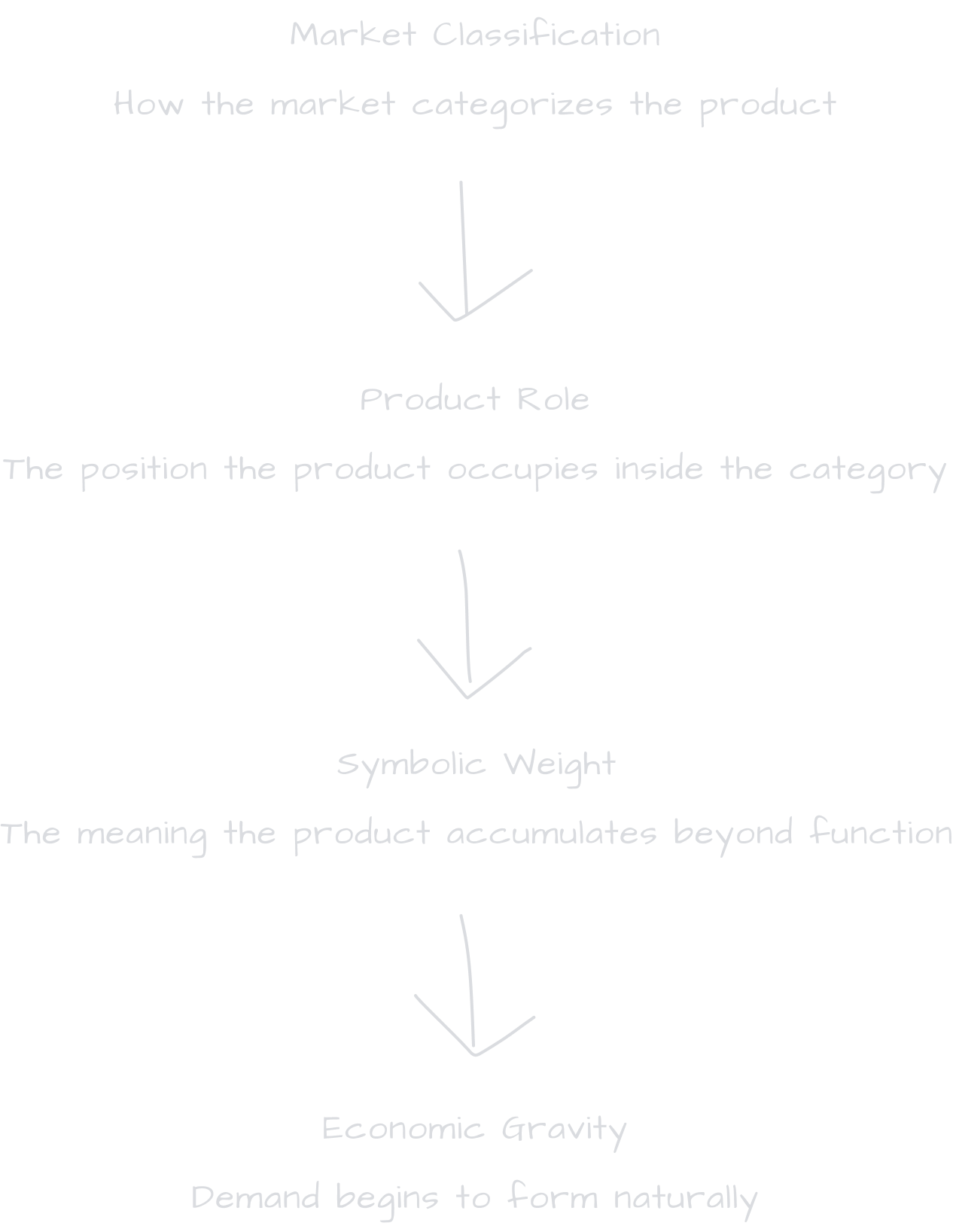
Markets evaluate products according to the role they occupy.
Some products lead the purchase. Others follow it.
When a product leads, it defines the decision.
When it follows, it completes one that has already been made.
That role is rarely explicit.
Yet it shapes how customers interpret the object in front of them.
Is it infrastructure?
An accessory?
A tool?
Or something chosen — something that carries meaning beyond its function?
Each role produces its own economic behavior.
Infrastructure is compared.
Accessories are negotiated.
Identity objects are chosen.
Once the role is established, the economics follow.
Role Determines Gravity.
When a product is mentally filed as an accessory, it behaves like one.
When it becomes something central — something chosen rather than simply used — the dynamics begin to shift.
Pressure decreases.
Pull begins to form.
I began exploring this question inside a company called Naked Root.
At first glance, nothing was broken.
The product worked. Customers were buying.
Still something felt structurally off.
Growth existed, but required constant effort.
Momentum appeared only when marketing pressure increased.
It became clear the planter had been mentally filed as an accessory — something that supported the plant rather than something chosen beside it.
That classification defined the economics of the product.
Over the following year we redesigned the system surrounding the object.
Not simply the marketing.
The role.
How the product appeared inside the home.
How the brand introduced signals into the market.
How customers encountered the object and interpreted its presence.
Gradually the classification began to shift.
The planter stopped behaving like infrastructure and began behaving like something authored — an object chosen for its presence rather than tolerated for its function.
The economic consequences followed.
Monthly revenue moved from roughly $30k to nearly $200k.
But the most interesting change was not the numbers.
It was the structure.
Growth stopped requiring constant pressure.
The product began to carry its own gravity.
Some products generate demand.
Others require constant effort to sustain it.
This case study shows what changes when that dynamic is reversed.
Read the Case Study
Reading time: ~12 minutes
If you built a product you believe in, yet growth increasingly feels like effort rather than momentum, the issue may not be marketing.
The market may have filed the product in the wrong role — and once that happens, the economics follow.
Because in markets, as in physics,
role determines gravity.
Observations on how products are understood — and how that understanding shapes what they become.
Why Most Products Are Not Weak — They Are Misclassified
Why Marketing Feels Like Pressure for Some Products — and Pull for Others